Best Socks for Boots at -25°F: My Journey From a NYC Commute to a Canadian Cabin
If you’ve ever traveled from a damp New York winter straight into the deep freeze of rural Canada, you know the cold doesn’t just “exist”—it stalks you. And while most people obsess over heavy jackets or expensive boots, experienced winter travelers know the truth: your feet determine whether you feel warm or frozen.
That’s why choosing the right socks for boots mattered more than choosing the right coat on my recent trip.
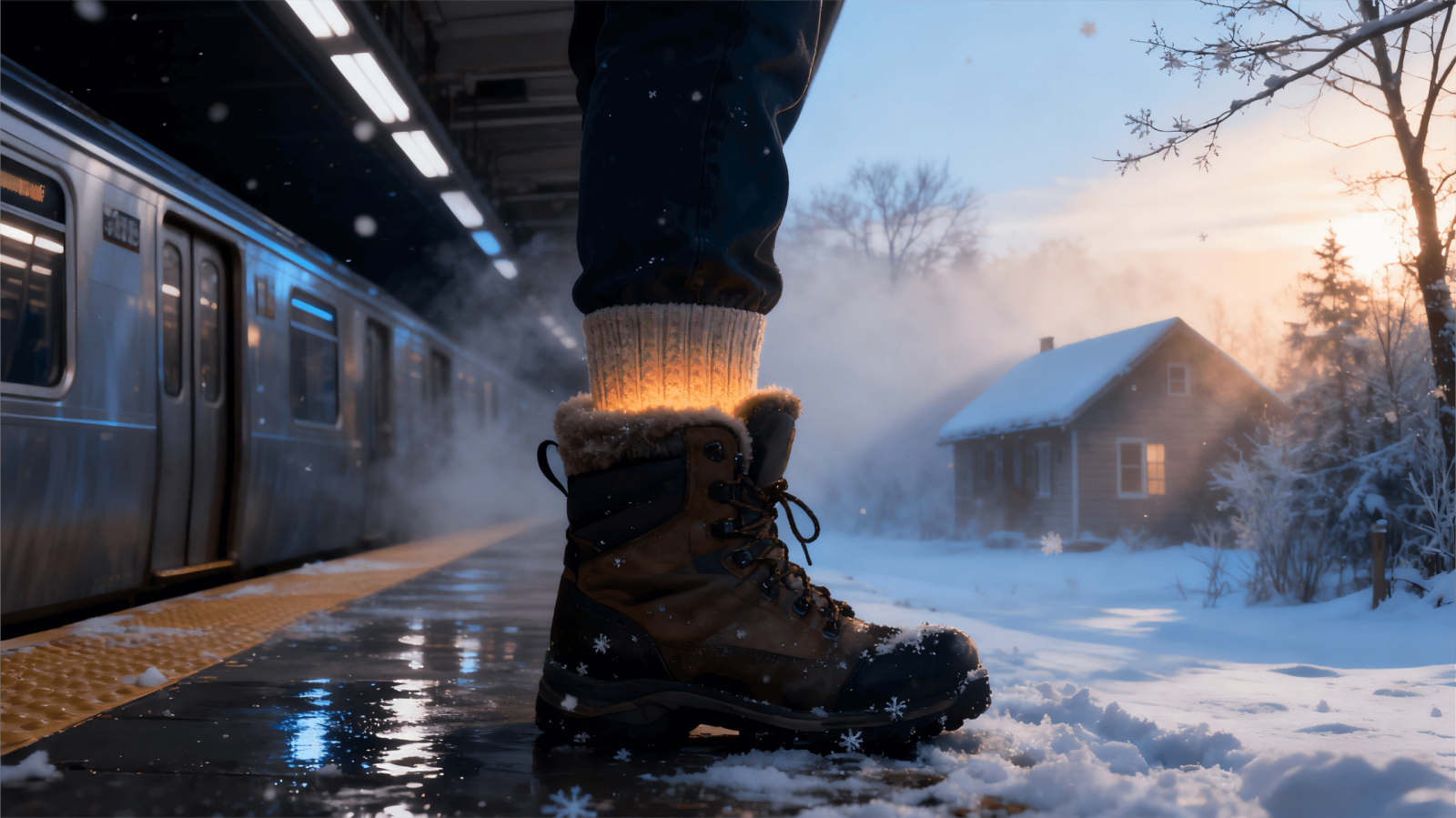
New York’s moisture-heavy cold hits you on subway platforms, where ground humidity creeps upward. Canada’s cold hits differently—dry, sharp, and punishing at -25°F. According to Environment Canada, winter wind chills regularly fall to “dangerously low levels capable of freezing skin in minutes.”
When your feet lose heat, your entire body spirals downward—fast.
This time, instead of buying yet another pair of insulated boots, I fixed the real problem: what goes inside them.
Why Good Socks for Boots Matter More Than the Boots Themselves
People assume expensive insulated boots are enough. But boots only trap warmth—socks create and manage it.
If your socks aren’t insulating, moisture-wicking, and stable, your feet will still freeze no matter how much you spent on footwear.
- Urban Winter (NYC): Slush, wet concrete, constant temperature shifts.
- Wilderness Cold (Canada): Subzero windchill, dry snow, frozen ground.
Weather.gov explains that moisture drastically increases perceived cold; wet conditions can accelerate heat loss by up to 25%. This brings us to the most common mistake people make: wearing the wrong type of cotton.
The \”Ordinary Cotton\” Trap: Why 100% Cotton Fails
You\’ve probably heard the saying \”Cotton Kills\” in the hiking world. This refers specifically to standard, 100% cotton socks.
Why? Because ordinary cotton absorbs moisture like a sponge and loses its insulating properties once wet. As the Mayo Clinic confirms, damp clothing accelerates heat loss and increases frostbite risk. If you wear basic cotton gym socks inside winter boots, your sweat gets trapped, cools down, and turns your toes into ice blocks.
The Problems With Ordinary Winter Socks:
- Too bulky: Toe compression reduces circulation (making you colder).
- Sweat trapped against skin: Feet get clammy and freeze.
- Slip-down ankles: Leading to blisters during long walks.
My old cotton-wool blend socks stayed damp all morning in the New York slush. In Quebec, they froze solid overnight in the cabin mudroom. Not exactly “winter performance.”
The Solution: Engineered Hybrid Blends
That’s when I switched to socks engineered for real winter travel. I needed the softness of cotton but without the moisture retention.
Review: CLOSEMATE Women’s Winter Thermal Casual Boot Socks
This season’s standout is the CLOSEMATE Women’s Winter Thermal Casual Boot Socks—built specifically for winter boots and subzero environments.
What makes them different is the scientific material blend. Instead of relying on just one fabric, they use a hybrid approach to get the best of all worlds:

The Material Breakdown (The \”Golden Ratio\”):
- 43% Acrylic: Provides high insulation-to-weight ratio (retains warmth even when damp).
- 42% Combed Cotton: High-quality combed cotton offers superior softness and breathability without the bulk of cheap cotton.
- 10% Polyester & 5% Spandex: Essential for moisture management, structure, and that crucial \”stay-up\” fit.
Textile Exchange notes that acrylic mimics the warmth of wool but often performs better in moisture management when blended correctly. This specific blend allows the cotton to provide comfort against the skin, while the acrylic and polyester wick the moisture away to the outer layer.
Performance Test: Warmth That Actually Lasts
Test 1: The NYC Slush Commute My first test was a 40-minute walk to the subway in slushy Manhattan. For the first time all season, my feet stayed:
- Dry (The wicking worked)
- Insulated (No cold seeping in)
- Stable (No bunching up inside the boot)
Test 2: The -25°F Quebec Sunrise Then came the real test: a -25°F Quebec sunrise. The socks performed like technical hiking gear—without the scratchiness of raw wool. My feet stayed warm for hours, something I hadn’t experienced since childhood snow days.
Breathability: The Unexpected Hero
Most winter socks trap sweat.
In subzero temperatures, sweat = cold.
NIH research shows that moisture dramatically accelerates heat loss across extremities.
These thermal boot socks wick moisture fast enough to prevent freeze-down during:
- Hiking
- Shoveling snow
- Cabin chores
- Long walks on icy ground
This unique balance between insulation + ventilation is why they work both in NYC humidity and Canadian dry freeze.
Ready to Upgrade Your Winter Warmth?

Key Features to Include Next to Image
- Full-foot cushioning
- Dual-layer thermal interior
- Non-binding stay-up design
- Soft combed-cotton comfort
- Made specifically for winter boots
Perfect for shoppers who skim and need quick clarity.
The Small Upgrade That Changes Your Entire Winter
Winter comfort often comes down to small details. You don\’t necessarily need $300 boots; you might just need better engineering inside the ones you already own.
These thermal boot socks kept me warm from the wet concrete of New York to the frozen lakes of Canada. If you are preparing for a harsh winter, traveling north, or simply tired of cold toes ruining your day, this is one upgrade that genuinely pays off.
👉 Perfect for winter boots. Perfect for -25°F. Perfect for everyday life.
FAQS-Frequently Asked Questions About Winter Boot Socks
A: Great question! \”Cotton kills\” applies to 100% cotton socks which soak up sweat and stay wet. However, our socks use a technical hybrid blend. By mixing 42% Combed Cotton with 43% Acrylic and Polyester, we utilize the softness of cotton for comfort while the synthetic fibers actively pull moisture away from your skin. It’s the perfect balance of comfort and technical performance.
A: These are designed as mid-weight thermal socks. They feature targeted cushioning (terry loops) on the sole for warmth but are engineered to fit comfortably inside standard winter boots, hiking boots, and even roomy casual boots without cutting off circulation.
A: Not at all. This is the main advantage of our Acrylic-Cotton blend over traditional wool. You get the high thermal retention of wool without the itchiness or skin irritation, making them perfect for people with sensitive skin.
A: Absolutely. Because they are breathable and have a non-binding cuff (they don\’t squeeze your ankle too hard), many customers wear them as \”bed socks\” in drafty cabins or cold apartments to keep circulation going throughout the night.
A: To keep the thermal fibers lofty and effective, machine wash cold with like colors and tumble dry on low heat. Avoid bleach and ironing, as high heat can damage the elastic fibers that keep the socks staying up.